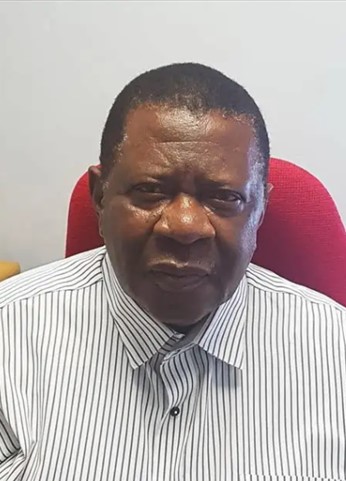
Where Others Feared, He Published
Today, as we bid farewell to Mr Joe Matthew Seshego Latakgomo (13 January 1948 – 22 February 2026), we do so not only in mourning but in remembrance of a life devoted to truth. The most fitting tribute to a journalist is the telling of his story. And his was the story of a man who understood that, under apartheid, the newsroom was not simply a place of employment, it was a site of struggle.
His contribution to South Africa’s liberation was not delivered from mass rallies or political podiums, but through disciplined editorial leadership, principled reporting, and the belief that truth itself was resistance. At a time when the apartheid state tightly controlled information, censored dissent, and criminalised Black political expression, Mr Latakgomo helped transform Black journalism into an instrument of accountability and empowerment.
Bra Joe, as he was fondly known, entered the profession in the 1960s, during one of the most repressive periods in South Africa’s history. Liberation movements were banned. Leaders were imprisoned or exiled. Censorship narrowed the space for expression. For Black journalists, the challenge was profound: to report on injustice while operating within systems designed to silence them.
By the early 1970s, he had risen to senior editorial roles at The World and Weekend World. In those newsrooms, alongside a courageous generation of writers and editors, he insisted that Black voices be placed at the centre of the national narrative. Forced removals, labour unrest, township poverty, and youth mobilisation were not treated as marginal stories; they were the country’s lived reality.
That commitment proved decisive in 1976, and Mr Latakgomo’s leadership was central to it.
As students mobilised against the imposition of Afrikaans as a medium of instruction, he ensured that The World approached their grievances with seriousness and depth. Under his editorial guidance, the newspaper recognised that what was unfolding in Soweto was not a passing disturbance, but a defining national moment. The voices of young people demanding dignity and equal education were given space, context, and legitimacy.
When the Soweto Uprising erupted on 16 June, Mr Latakgomo and his colleagues ensured that the country and the wider world bore witness. The images and testimonies published in The World challenged official narratives and revealed the human cost of state violence. Such reporting required careful judgment and quiet resolve. Without that steady editorial direction, the full significance of that day might not have reached beyond the townships.
The state responded decisively. In October 1977, amid a broader crackdown on Black Consciousness organisations and independent Black media, The World and Weekend World were banned. The closures reflected the extent to which publications under leaders like Mr Latakgomo had come to matter. In the eyes of the regime, their journalism had become too influential to be tolerated.
Yet repression did not silence him. In 1981, Mr Latakgomo became the founding editor of The Sowetan, rebuilding a national Black press voice during the turbulent years of states of emergency, mass detentions, and escalating political violence. Under his steady stewardship, the paper evolved into one of the country’s most influential publications, documenting civic resistance, labour activism, and community struggles while maintaining credibility under constant threat.
He believed professionalism was not a weakness. Accuracy was not compromised. Balance was not surrender. Credibility, he demonstrated, was what allowed journalism to endure beyond repression.
As South Africa entered the uncertain years of negotiation and democratic transition, he continued to guide readers with clarity and restraint. He understood journalism not only as reporting events, but as civic education, helping citizens interpret power, change, and possibility.
His career, spanning repression and democracy, reflected decades of principled commitment. Even after 1994, he remained engaged in conversations about media ethics, transformation, and accountability in a free South Africa.
Today, as we reflect on his legacy, we are reminded that many of the liberation struggle’s most consequential battles were fought not only in courts and on the streets, but in editorial meetings and on printing presses. Much of that history remains preserved in fragile, undigitised archives, a quiet testimony to journalists who refused to let the truth be erased.
Mr Joe Matthew Seshego Latakgomo believed journalism was a public trust. In a country where information was weaponised to divide and control, he reclaimed it as a tool for liberation.
South Africa’s democratic media landscape stands, in part, on foundations laid by journalists like him — men and women who understood that telling the truth, even under threat, was itself an act of freedom.
Today, he was laid to rest in a Category Two State Special Official Provincial Funeral, awarded by President Cyril Ramaphosa and officiated by Gauteng Premier Panyaza Lesufi. It is a fitting honour.
But perhaps the truest tribute lies not in ceremony, but in continuation, in every newsroom that still believes the truth matters.
Mr Moses Mushi writes in his personal capacity as a journalist, inspired by the work and legacy of Mr Joseph Matthew Seshego Latakgomo.